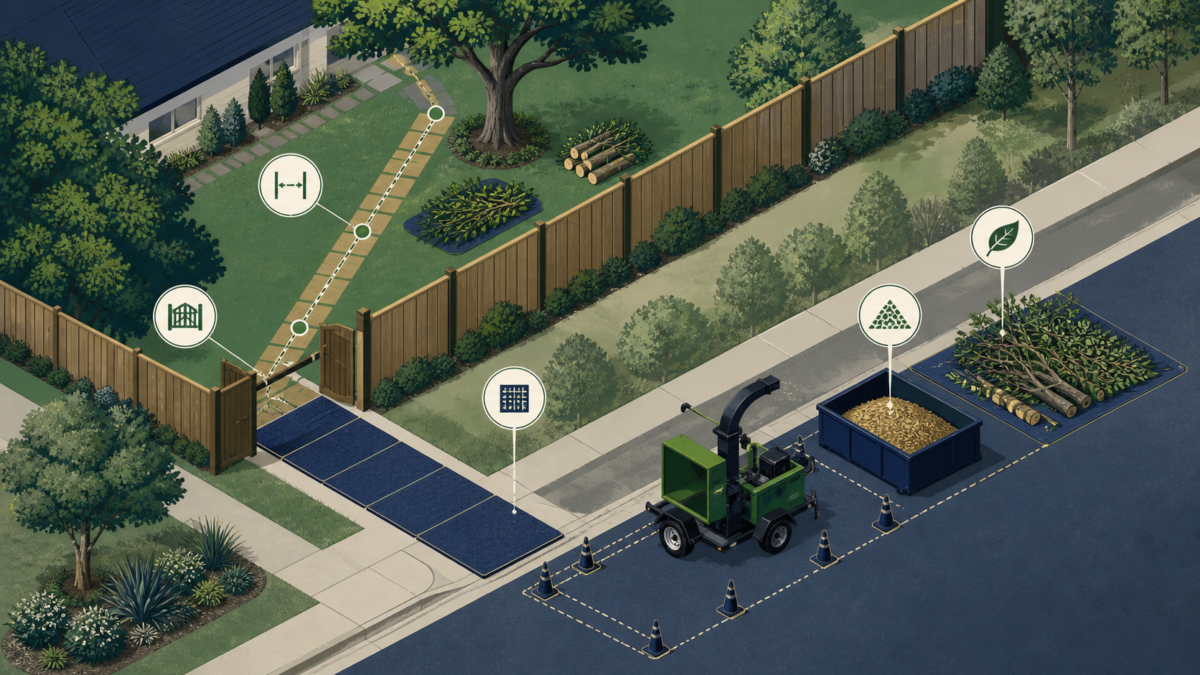
A narrow side yard or short driveway can make ordinary tree work a coordination problem. The useful first step is a route map: where people enter, where cut material moves, where a chipper or truck could stage, and what must remain protected. Do not assume an alley, curb, or front strip is available for equipment; if work affects public right-of-way, confirm current scope with the City of Hurst.
How should compact Hurst lot gates be measured for tree-service access?
Measure the clear opening, not just the gate panel. Note turns, steps, hose bibs, air-conditioning equipment, garden beds, overhead lines, and locked areas. Photos from both directions help show pinch points.
The Hurst yard-preparation guide provides a helpful pre-visit routine. Keep gates unlocked only as arranged and identify pets before arrival.
Tree debris and access planning for compact Hurst lots planning is strongest when observations are recorded in plain language: location, sequence, visible condition, access route, and nearby targets. Avoid treating one symptom as proof of a cause. A site review can distinguish the question that needs attention now from details that can be monitored as conditions change. Review tree trimming and pruning resources for maintenance context.
Tree debris and access planning for compact Hurst lots also benefits from a staged decision. First describe what is visible without assigning blame or predicting an outcome. Next identify who could be affected, what work area is available, and which facts need confirmation. Then preserve the notes, photos, and plan changes with the project record. This sequence makes it easier for everyone involved to discuss the same conditions and prevents a later decision from being based on a remembered detail rather than the site information.
What Hurst driveway and alley constraints affect tree debris routes?
An alley or driveway may be the practical route, but parking patterns, turning radius, neighbors, and public access can affect what is possible. Describe constraints rather than promising a vehicle position.
The estimate guide can help compare stated access, cleanup, and hauling assumptions.
Tree debris and access planning for compact Hurst lots planning is strongest when observations are recorded in plain language: location, sequence, visible condition, access route, and nearby targets. Avoid treating one symptom as proof of a cause. A site review can distinguish the question that needs attention now from details that can be monitored as conditions change. Share narrow-route details before an estimate.
Tree debris and access planning for compact Hurst lots also benefits from a staged decision. First describe what is visible without assigning blame or predicting an outcome. Next identify who could be affected, what work area is available, and which facts need confirmation. Then preserve the notes, photos, and plan changes with the project record. This sequence makes it easier for everyone involved to discuss the same conditions and prevents a later decision from being based on a remembered detail rather than the site information.
How can compact Hurst lot chipping be planned around people and property?
Chipping reduces branch volume but does not erase the need for a safe material path. Keep pets, children, vehicles, and windows outside the work zone, and ask where chips will go if they are retained.
If branches approach conductors, use the power-line branch safety guidance; overhead line safety is separate from debris logistics.
Tree debris and access planning for compact Hurst lots planning is strongest when observations are recorded in plain language: location, sequence, visible condition, access route, and nearby targets. Avoid treating one symptom as proof of a cause. A site review can distinguish the question that needs attention now from details that can be monitored as conditions change. Do not park in the planned material path.
Tree debris and access planning for compact Hurst lots also benefits from a staged decision. First describe what is visible without assigning blame or predicting an outcome. Next identify who could be affected, what work area is available, and which facts need confirmation. Then preserve the notes, photos, and plan changes with the project record. This sequence makes it easier for everyone involved to discuss the same conditions and prevents a later decision from being based on a remembered detail rather than the site information.
| Access detail | Why it matters | Question to record |
|---|---|---|
| Gate opening | Limits equipment and branch movement | What is the clear width? |
| Driveway or alley | Changes staging and public access | Where can vehicles be placed? |
| Chips and logs | Determines cleanup route | Remove, retain, or stage where? |
| Targets | Changes handling method | What must stay clear? |
When should Hurst tree haul-off scope be written before work begins?
A written scope should state whether brush, logs, chips, and small raked debris are removed, left, or placed in a named location. Haul-off is a logistics question, not a phrase that should be assumed.
For digging connected to a stump or access repair, contact Texas 811 before digging. Marking utilities does not authorize public-area staging.
Tree debris and access planning for compact Hurst lots planning is strongest when observations are recorded in plain language: location, sequence, visible condition, access route, and nearby targets. Avoid treating one symptom as proof of a cause. A site review can distinguish the question that needs attention now from details that can be monitored as conditions change. Keep overhead obstacles visible in photos.
Tree debris and access planning for compact Hurst lots also benefits from a staged decision. First describe what is visible without assigning blame or predicting an outcome. Next identify who could be affected, what work area is available, and which facts need confirmation. Then preserve the notes, photos, and plan changes with the project record. This sequence makes it easier for everyone involved to discuss the same conditions and prevents a later decision from being based on a remembered detail rather than the site information.
Why do compact Hurst lot targets change tree debris handling?
A patio, pool equipment, fence, roof edge, utility line, vegetable bed, and parked vehicle are all targets that change the material-handling discussion.
The ISA risk guidance explains why targets and tree condition are considered together.
Tree debris and access planning for compact Hurst lots planning is strongest when observations are recorded in plain language: location, sequence, visible condition, access route, and nearby targets. Avoid treating one symptom as proof of a cause. A site review can distinguish the question that needs attention now from details that can be monitored as conditions change. Record special cleanup requests in writing.
Tree debris and access planning for compact Hurst lots also benefits from a staged decision. First describe what is visible without assigning blame or predicting an outcome. Next identify who could be affected, what work area is available, and which facts need confirmation. Then preserve the notes, photos, and plan changes with the project record. This sequence makes it easier for everyone involved to discuss the same conditions and prevents a later decision from being based on a remembered detail rather than the site information.
What compact Hurst lot access checklist helps before tree work?
Use the checklist to prepare access without attempting to move hazardous limbs.
Infographic concept: show a compact parcel from above with a measured gate, side-yard turn, protected patio, chipper zone, truck route, debris arrows, and a “do not stand here” drop zone.
Tree debris and access planning for compact Hurst lots planning is strongest when observations are recorded in plain language: location, sequence, visible condition, access route, and nearby targets. Avoid treating one symptom as proof of a cause. A site review can distinguish the question that needs attention now from details that can be monitored as conditions change. Use the planning category for related preparation.
Tree debris and access planning for compact Hurst lots also benefits from a staged decision. First describe what is visible without assigning blame or predicting an outcome. Next identify who could be affected, what work area is available, and which facts need confirmation. Then preserve the notes, photos, and plan changes with the project record. This sequence makes it easier for everyone involved to discuss the same conditions and prevents a later decision from being based on a remembered detail rather than the site information.
Infographic concept: show a top-down Hurst compact lot access plan with gates, driveway, alley, protected targets, material arrows, chipper zone, truck staging, and cleanup choices The drawing would be an educational planning aid, not a site measurement or instruction to undertake hazardous work.
- Measure gates and narrow turns.
- Photograph driveway, alley, and side-yard routes.
- Move vehicles and fragile outdoor items.
- Identify pets, locks, and irrigation hardware.
- Ask how chips, logs, and brush are handled.
- Confirm any public-edge staging with the City.
- Keep the route clear on the scheduled day.
What Hurst tree debris questions clarify cleanup and access?
A clear description of cleanup prevents the common mismatch between a homeowner’s expectation and the site constraints that were actually observed.
For removal-specific context, see the Hurst tree removal process.
Tree debris and access planning for compact Hurst lots planning is strongest when observations are recorded in plain language: location, sequence, visible condition, access route, and nearby targets. Avoid treating one symptom as proof of a cause. A site review can distinguish the question that needs attention now from details that can be monitored as conditions change. Use the contact page to send access notes.
Tree debris and access planning for compact Hurst lots also benefits from a staged decision. First describe what is visible without assigning blame or predicting an outcome. Next identify who could be affected, what work area is available, and which facts need confirmation. Then preserve the notes, photos, and plan changes with the project record. This sequence makes it easier for everyone involved to discuss the same conditions and prevents a later decision from being based on a remembered detail rather than the site information.
Where is Hurst Tree Service located for compact-lot access planning?
Use the verified business map below to confirm the Hurst service location and plan your route. Contact the business directly to confirm current availability and project scope.
What compact Hurst lot tree debris FAQs clarify access and cleanup?
Should I measure the gate before requesting tree service?
Yes. Measure the clear opening and note turns, steps, overhead obstacles, and anything that blocks a side-yard route.
Does haul-off always include every kind of debris?
Confirm the written scope. Brush, logs, chips, and raked debris may have different handling arrangements.
Can a crew stage in a Hurst alley or curb area?
Do not assume so. Describe the location and confirm current City requirements when public right-of-way may be affected.
What should I move before tree debris work?
Move vehicles and fragile outdoor items from the planned route, and identify pets, gates, irrigation, and access restrictions.
Why mention a patio or fence during an estimate?
These are targets that can affect the material path, work zone, and cleanup method.
With the observations, access details, and questions gathered, Hurst Tree Service can discuss an appropriate scope. Use the contact page to share the site details and timing.