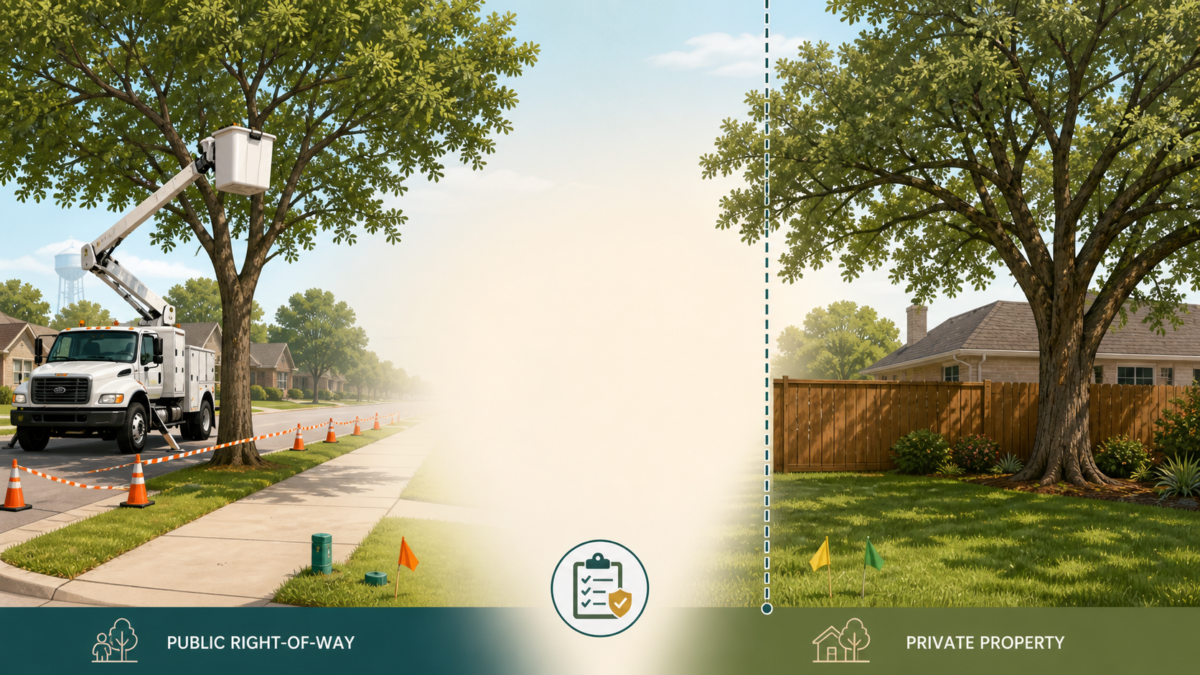
Tree limbs over a sidewalk, alley, street, or driveway can make a simple maintenance job feel like a permitting question. The useful first step is not to assume from a fence line or curb. It is to identify where the work will happen, where people and equipment must stand, and whether aerial work will occur in public right-of-way. That distinction affects the sequence of calls, the access plan, and the questions to bring to a tree-service estimate.
When does Hurst right-of-way tree trimming require a permit for aerial work?
The City of Hurst right-of-way construction permitting page says that digging or aerial work in the public right-of-way, including tree trimming, requires a permit. “Aerial work” matters because a crew, lift, rigging plan, or branch removal can occupy space above or alongside the public area even when the trunk appears close to a private lot. The statement is specific to public right-of-way work. It should not be stretched into a claim that every trimming task on private property needs the same permit.
Before scheduling, describe the actual work rather than using a broad label such as “trim the street tree.” Note the trunk location, limb destinations, street or alley frontage, overhead conductors, sidewalk use, and whether a bucket truck, lift, ropes, or traffic control may be needed. Ask the City to confirm the current permit requirement, boundary, application materials, and any conditions for the particular location. Municipal requirements can change, and a site-specific answer is more useful than a neighbor’s past experience.
Permit review is separate from safety judgment. A permit does not make contact with an energized line safe, and it does not establish that a tree is sound. If limbs are near conductors, keep people and tools clear and coordinate with the utility as appropriate. The International Society of Arboriculture explains that a tree-risk assessment considers the tree, possible defects, and targets that could be struck; that perspective helps prioritize an inspection while the access question is being resolved.
How can Hurst homeowners confirm a tree trimming boundary near a curb or alley?
Visible landscape features are useful clues, not legal measurements. A fence may sit inside a parcel; a planted strip may be maintained by a homeowner while still bordering public right-of-way; and an alley can create a second public-facing edge. Start with property records, a survey if available, and the City’s current guidance. When uncertainty remains, ask the responsible City office what information it needs to confirm the boundary. A clear photo, street address, and sketch showing curb, sidewalk, alley, tree, and proposed work can make that conversation more productive.
Separate the boundary question from ownership and maintenance assumptions. A mature tree’s trunk can be on private property while limbs extend over a public area, or a planting can sit in an area subject to public controls. Rather than making a universal statement about responsibility, document what you know and confirm the present scope with the City. If a contractor will stage a vehicle, place a chipper, or manage pedestrians near the street, include those details in the planning conversation.
For a practical pre-visit checklist, see how to prepare a Hurst yard for tree service. It helps identify gates, parking, overhead obstacles, pets, and access routes before work begins. If branches approach utility equipment or conductors, the related Hurst power-line branch guidance is a useful safety reminder.
Does private-yard Hurst tree trimming need the same right-of-way permit?
Not necessarily. The City language in this guide concerns digging or aerial work in the public right-of-way. A trimming job fully within a private yard may present different questions, such as access, utility clearance, drainage, an HOA rule, or a shared boundary. It is not accurate to state that a right-of-way permit automatically applies to all private-yard pruning. If the tree or work area is near a public edge, ask the City to confirm the boundary and current scope instead of relying on a general rule.
This distinction is especially important when a crew can reach a tree from more than one side. A backyard pruning plan may be possible through a gate, while a larger removal or a limb over a street could require a different staging arrangement. Discuss alternatives during the estimate: ground-based pruning where suitable, private-side access, timing that minimizes disruption, or a permit path when public right-of-way activity is necessary. The right option depends on tree condition, branch size, targets, and site access.
Utility location is another separate step. If a project includes digging for a stump, fence, irrigation repair, or other excavation, contact Texas 811 before digging and follow its current process. Utility marking does not determine a property boundary or replace City confirmation, but it is part of prudent excavation planning. Private lines may require additional locating beyond the public utility-marking request.
What should a Hurst tree trimming permit request describe for a clear review?
Give reviewers a compact, factual picture: address; nearest cross street; whether the location faces a street, sidewalk, or alley; tree count; proposed trimming objective; expected equipment; and whether aerial work, digging, parking, or pedestrian management is involved. Include clear photos from both directions and mark the tree and public features on a simple sketch. Avoid guessing at a boundary in the request; label it as a question for confirmation.
A useful trimming objective is specific. Examples include removing a broken limb over a walkway, improving clearance from a structure, or addressing a branch that conflicts with access. “Make it smaller” is not a work plan. A qualified assessment should consider branch attachment, decay indicators, canopy distribution, and targets. The ISA’s hazards and risk guidance explains why both the likelihood of failure and the consequences around the tree matter.
| Site detail | Why it matters | Useful question |
|---|---|---|
| Street, sidewalk, or alley | May indicate public right-of-way activity | Is a permit required for this scope? |
| Lift, truck, or rigging | Can affect aerial-work and staging review | Where may equipment be placed? |
| Overhead utilities | Creates a separate safety concern | Who should be contacted first? |
| Digging or stump work | Requires utility-location planning | When should Texas 811 be contacted? |
This table is a planning aid, not a permit determination. Keep City instructions with the project record so everyone is working from the current site-specific answer.
How should Hurst residents plan safe access around right-of-way tree work?
Start with people, then equipment. Keep vehicles, pedestrians, pets, and outdoor items outside the planned work area. Identify curbside parking, school or commuter periods, mailboxes, fences, roof lines, and driveways. If a limb is over a travel path, do not stand beneath it to inspect closely or attempt a do-it-yourself cut. A branch can move unpredictably when weight is removed, especially after wind damage or when decay is present.
Make access constraints visible during the estimate. Measure gate openings, point out narrow side yards, and say whether the street or alley is the only workable route. The article on comparing Hurst tree-service estimates can help you ask whether cleanup, hauling, traffic-related setup, and permit coordination are included or excluded. Scope clarity reduces surprises without promising that any one access method will work at every site.
Infographic concept: show a top-down “private lot or public right-of-way?” decision map. It would label the curb, sidewalk, alley, parcel edge, tree trunk, canopy, lift position, and pedestrian zone, then direct readers to City confirmation when any work crosses into public space. A second small panel would separate permit confirmation, utility safety, and Texas 811 digging steps so readers do not treat them as interchangeable.
Good planning also means preserving uncertainty where it belongs. A condition seen from the ground can suggest a question, but it cannot by itself establish the cause, the amount of work needed, or the safest method. Record whether the issue followed a storm, drought period, construction change, irrigation adjustment, or ordinary seasonal change. Note whether the concern is isolated to one branch or affects the whole canopy, and whether there are cracks, mushrooms, lifted soil, exposed roots, or new conflicts with a roof or driveway. Then compare that record with the site’s access constraints and targets. This approach supports a more useful conversation because it distinguishes what has been observed from what still needs professional or agency confirmation. It also avoids two common mistakes: treating a visual symptom as a complete diagnosis, and treating a generic online recommendation as permission to alter a tree or work area. Where a decision could affect public space, utilities, a building, or a neighbor’s access, pause and verify the current responsible-party requirements. Keep written instructions with project notes, especially if the scope changes after inspection. A careful sequence—observe, secure the area, document, confirm responsibilities, then choose an appropriate scope—helps homeowners make measured decisions without inventing risk, cost, or outcome claims.
Use a staged review when the site has more than one issue. First identify immediate targets: people, occupied rooms, vehicles, public walking routes, utility equipment, and access lanes. Second, identify physical constraints: branch height, trunk position, slope, ground condition, gates, fences, parked cars, irrigation hardware, and adjacent property. Third, identify administrative constraints, including public-space boundaries, utility procedures, construction sequencing, or written property rules that may apply. These lists do different jobs. Targets guide urgency; physical constraints guide safe methods; administrative constraints guide who must confirm the work. Combining them too early can lead to false conclusions, such as treating a pruning preference as a safety emergency or assuming that a visible curb establishes a boundary. A concise written list also helps when several people are involved. Share the same facts with a builder, utility, City office, or tree-care provider rather than retelling the situation from memory. Ask each party only the question it is positioned to answer. City staff can clarify current public right-of-way process; utility representatives can address their facilities; a site review can consider tree condition and access; and a construction professional can address planned building work. If new evidence changes the plan, update the record rather than proceeding on an old assumption. This measured process is particularly valuable after a storm or during a time-sensitive project, when pressure to act quickly can obscure safety and coordination details.
What Hurst right-of-way tree trimming checklist helps before scheduling?
- Photograph the tree, curb or alley, sidewalk, and proposed access route.
- Write the objective: broken limb, clearance, inspection, or other defined need.
- Ask the City to confirm the present right-of-way boundary and permit scope.
- Identify overhead utilities and keep clear of energized lines.
- Contact Texas 811 before any planned digging.
- Compare written scopes for access, cleanup, and permit-related responsibilities.
- Keep the work zone clear on the scheduled day.
Use the checklist as a record of questions, not as a substitute for City direction or a site assessment. For broader planning resources, visit the Hurst tree-service planning category.
For current boundary and application details, consult the City of Hurst right-of-way permitting page before scheduling public right-of-way activity.
Where is Hurst Tree Service located for local tree-care planning?
Use the verified business map below to confirm the Hurst service location and plan your route. Contact the business directly to confirm current availability and project scope.
What Hurst right-of-way permit questions should homeowners ask before tree trimming?
Does every tree beside a Hurst street need a permit?
No blanket answer is reliable. The City states that digging or aerial work, including trimming, in public right-of-way requires a permit; confirm the boundary and current scope with the City.
Can a private-yard trimming job use the same permit rule?
Do not assume so. A private-yard job may be outside the public right-of-way rule, but a nearby public edge or aerial work can change the question.
Should I call Texas 811 for branch trimming?
Texas 811 is relevant before digging. It does not replace City boundary or permit confirmation, and overhead line safety remains a separate issue.
What if a limb is near a power line?
Keep clear and contact the utility or an appropriately qualified professional. Do not attempt pruning near energized conductors yourself.
Where can I request Hurst tree-service help after planning?
Review the project details, then use the Hurst Tree Service contact page to discuss site access and scope.
When you have a clear site description and current City direction, Hurst Tree Service can help you discuss a practical tree-work scope and access plan.