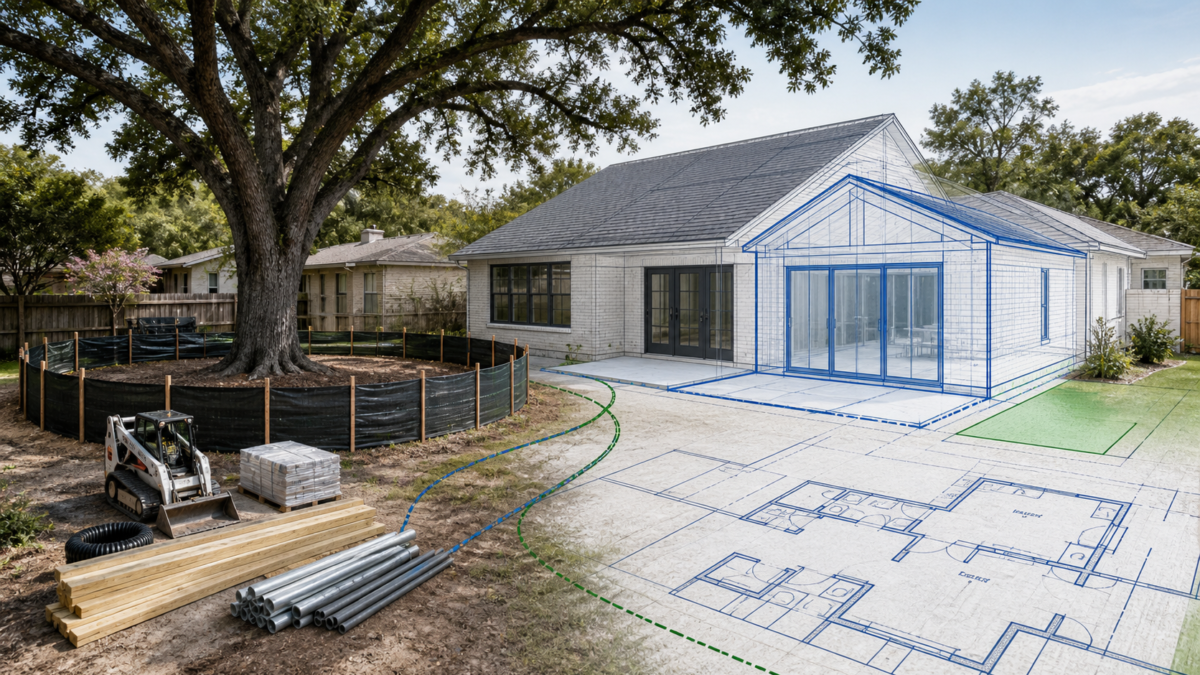
A home addition can affect a tree long before framing is visible. Survey stakes, trenching, material storage, repeated vehicle passes, and grade changes can alter the soil and roots that support a canopy. The useful conversation begins with the site plan, not with a promise that any tree can simply be “saved.” Review parcel information through the Web Soil Survey and discuss the actual construction sequence with the builder and tree-care provider.
How should Hurst construction root zones be mapped before an addition?
Mark trunk locations, canopy edges, driveways, fences, planned walls, and every anticipated utility path on one working drawing. A root-protection area should be a deliberate project constraint rather than an informal request made after equipment arrives.
The Hurst preconstruction tree-protection guide helps turn that drawing into a job-site conversation. Tree size, species, condition, and the proposed footprint all matter; no single distance fits every parcel.
Construction root protection for a Hurst home addition planning is strongest when observations are recorded in plain language: location, sequence, visible condition, access route, and nearby targets. Avoid treating one symptom as proof of a cause. A site review can distinguish the question that needs attention now from details that can be monitored as conditions change. Use property-planning resources to organize the early questions.
Construction root protection for a Hurst home addition also benefits from a staged decision. First describe what is visible without assigning blame or predicting an outcome. Next identify who could be affected, what work area is available, and which facts need confirmation. Then preserve the notes, photos, and plan changes with the project record. This sequence makes it easier for everyone involved to discuss the same conditions and prevents a later decision from being based on a remembered detail rather than the site information.
Why do Hurst addition trenches need root-aware routing decisions?
Utility trenches are often adjusted in the field, which makes early route review valuable. Ask whether a route can avoid the most sensitive area, whether boring or another method is proposed, and who will stop work if substantial roots are encountered.
The tree roots and foundation resource is useful for separating foundation observations from unsupported assumptions about roots. Coordinate utility questions with the people responsible for the utility design and excavation.
Construction root protection for a Hurst home addition planning is strongest when observations are recorded in plain language: location, sequence, visible condition, access route, and nearby targets. Avoid treating one symptom as proof of a cause. A site review can distinguish the question that needs attention now from details that can be monitored as conditions change. Compare scopes with the Hurst estimate guide when tree-related work is separately proposed.
Construction root protection for a Hurst home addition also benefits from a staged decision. First describe what is visible without assigning blame or predicting an outcome. Next identify who could be affected, what work area is available, and which facts need confirmation. Then preserve the notes, photos, and plan changes with the project record. This sequence makes it easier for everyone involved to discuss the same conditions and prevents a later decision from being based on a remembered detail rather than the site information.
How can Hurst construction compaction affect tree root conditions?
Compaction is not just a muddy-day inconvenience. Repeated loading can reduce pore space and change how water and air move through soil. Keep stockpiles, dumpsters, and parking outside the agreed protection area.
Texas A&M AgriLife Extension provides Texas-oriented horticultural context, while the job site still needs its own written access controls. Do not compensate for a weak route plan by pruning roots casually.
Construction root protection for a Hurst home addition planning is strongest when observations are recorded in plain language: location, sequence, visible condition, access route, and nearby targets. Avoid treating one symptom as proof of a cause. A site review can distinguish the question that needs attention now from details that can be monitored as conditions change. Keep irrigation, drainage, and soil observations in the project record.
Construction root protection for a Hurst home addition also benefits from a staged decision. First describe what is visible without assigning blame or predicting an outcome. Next identify who could be affected, what work area is available, and which facts need confirmation. Then preserve the notes, photos, and plan changes with the project record. This sequence makes it easier for everyone involved to discuss the same conditions and prevents a later decision from being based on a remembered detail rather than the site information.
| Construction item | Tree-planning question | Record to keep |
|---|---|---|
| Utility route | Can it avoid the protection area? | Approved route sketch |
| Material storage | Where will loading occur? | Staging map |
| Fence opening | Who may move it? | Site instruction |
| Grade change | What soil level changes are planned? | Revised plan |
What fencing details protect Hurst trees during home-addition access?
A barrier works only when crews understand its purpose and it remains in place. Identify gate locations, delivery turns, temporary staging, and who is authorized to move fencing. Do not attach materials or equipment to a tree.
Photograph the fence after installation and at major construction transitions. A visible, maintained barrier is easier to preserve than a verbal rule, particularly when subcontractors and deliveries change from week to week.
Construction root protection for a Hurst home addition planning is strongest when observations are recorded in plain language: location, sequence, visible condition, access route, and nearby targets. Avoid treating one symptom as proof of a cause. A site review can distinguish the question that needs attention now from details that can be monitored as conditions change. Share fencing rules at the preconstruction meeting.
Construction root protection for a Hurst home addition also benefits from a staged decision. First describe what is visible without assigning blame or predicting an outcome. Next identify who could be affected, what work area is available, and which facts need confirmation. Then preserve the notes, photos, and plan changes with the project record. This sequence makes it easier for everyone involved to discuss the same conditions and prevents a later decision from being based on a remembered detail rather than the site information.
When should Hurst addition grade changes be reviewed around tree roots?
A raised or lowered grade can change the root environment even when no root is visibly cut. Put proposed drainage, fill, paving, and swales on the same plan as existing trees, then review changes before installation.
The ISA mature-tree care reference is a useful reminder that established trees respond to cumulative site changes. Record what is proposed rather than describing a future result as certain.
Construction root protection for a Hurst home addition planning is strongest when observations are recorded in plain language: location, sequence, visible condition, access route, and nearby targets. Avoid treating one symptom as proof of a cause. A site review can distinguish the question that needs attention now from details that can be monitored as conditions change. Recheck access after a change order.
Construction root protection for a Hurst home addition also benefits from a staged decision. First describe what is visible without assigning blame or predicting an outcome. Next identify who could be affected, what work area is available, and which facts need confirmation. Then preserve the notes, photos, and plan changes with the project record. This sequence makes it easier for everyone involved to discuss the same conditions and prevents a later decision from being based on a remembered detail rather than the site information.
What Hurst construction root protection checklist helps before work starts?
Use the checklist to create a shared record for owner, designer, builder, and tree-care discussion.
Before a service visit, the yard preparation guide can help identify gates, irrigation components, and nearby structures.
Construction root protection for a Hurst home addition planning is strongest when observations are recorded in plain language: location, sequence, visible condition, access route, and nearby targets. Avoid treating one symptom as proof of a cause. A site review can distinguish the question that needs attention now from details that can be monitored as conditions change. Do not begin protection after heavy equipment has already crossed the area.
Construction root protection for a Hurst home addition also benefits from a staged decision. First describe what is visible without assigning blame or predicting an outcome. Next identify who could be affected, what work area is available, and which facts need confirmation. Then preserve the notes, photos, and plan changes with the project record. This sequence makes it easier for everyone involved to discuss the same conditions and prevents a later decision from being based on a remembered detail rather than the site information.
Infographic concept: show a plan-view parcel with an addition footprint, tree trunks, a root-protection boundary, utility alternatives, delivery route, fence gate, and no-storage zone The drawing would be an educational planning aid, not a site measurement or instruction to undertake hazardous work.
- Inventory trees and target areas.
- Overlay addition, utilities, and access routes.
- Set and document the protection fence.
- Keep stockpiles and parking outside it.
- Review trench and grade changes before work.
- Photograph conditions at milestones.
- Update all parties when the plan changes.
What Hurst home-addition tree questions clarify changing site conditions?
Construction plans evolve, so a checkpoint after excavation and another before final landscaping can catch changes that were not visible at the first meeting.
For public-edge activity, the City of Hurst says digging or aerial work, including trimming, in public right-of-way requires a permit; confirm present boundary and scope with the City.
Construction root protection for a Hurst home addition planning is strongest when observations are recorded in plain language: location, sequence, visible condition, access route, and nearby targets. Avoid treating one symptom as proof of a cause. A site review can distinguish the question that needs attention now from details that can be monitored as conditions change. Use the contact page to provide the plan and site constraints.
Construction root protection for a Hurst home addition also benefits from a staged decision. First describe what is visible without assigning blame or predicting an outcome. Next identify who could be affected, what work area is available, and which facts need confirmation. Then preserve the notes, photos, and plan changes with the project record. This sequence makes it easier for everyone involved to discuss the same conditions and prevents a later decision from being based on a remembered detail rather than the site information.
For construction questions touching public right-of-way, review the City of Hurst right-of-way permitting information. The ISA mature-tree care resource provides additional established-tree context.
Where is Hurst Tree Service located for construction tree-planning questions?
Use the verified business map below to confirm the Hurst service location and plan your route. Contact the business directly to confirm current availability and project scope.
What Hurst construction root protection FAQs help addition planning?
Can a tree be protected after construction has already started?
It may still be useful to document conditions and reduce additional disturbance, but the best opportunity is before routes, storage, and fencing are set.
Should a trench be placed wherever it is shortest?
Not automatically. Review the route against trees, protection areas, utilities, and the construction plan before excavation.
Does a fence guarantee a Hurst tree will be unaffected?
No. It is an access-control tool; grade, drainage, root cutting, and site changes still need project-specific review.
Why record material storage locations?
Storage and repeated traffic can change soil conditions, so a written staging plan makes the restriction visible to crews.
When should the protection plan be updated?
Update it whenever utility routing, addition footprint, grade, deliveries, or access changes.
With the observations, access details, and questions gathered, Hurst Tree Service can discuss an appropriate scope. Use the contact page to share the site details and timing.