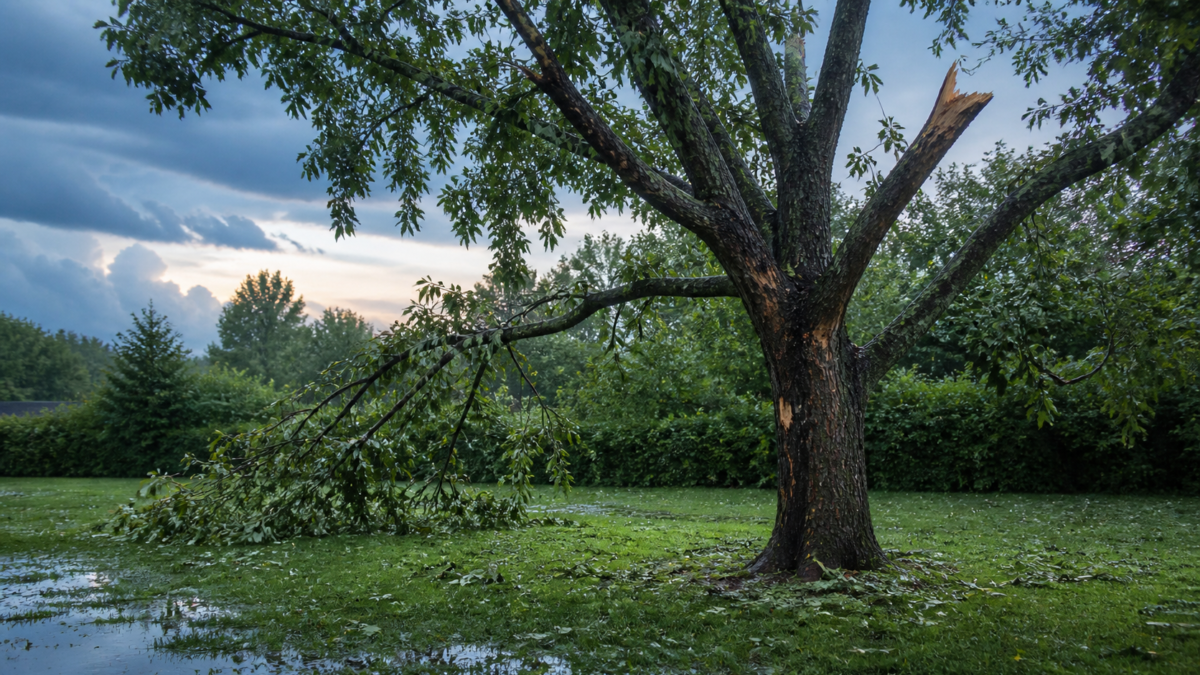
Hail can leave a tree looking dramatically different in one afternoon. Shredded leaves, fresh bark scrapes, twig litter, and snapped tips are easy to see; internal injury, loosened attachments, and the tree’s ability to recover are less obvious. In Hurst, a useful response separates immediate hazards from cosmetic debris and records what changed before hurried cutting begins. The National Weather Service offers North Texas preparedness information through its preparedness resources, while Ready.gov severe-weather guidance supports the larger household safety plan.
How should Hurst hail-damaged tree hazards be triaged after the first storm?
Begin outside the drop zone. Look for limbs caught in other branches, a split trunk, a branch resting on a roof, disturbed soil at the base, or a new lean toward a driveway or walkway. Do not pull on a lodged limb, climb to inspect it, or work beneath it. A broken tip high in the canopy may be less urgent than a smaller limb over a door, parked car, or public path because targets change the consequence of failure.
Make a short hazard note: location, what is visibly damaged, what could be struck, and whether access is restricted. If a limb is on a roof, the site-specific Hurst limb-on-roof guidance can help organize the next questions. For broad storm preparation and post-storm observations, review the storm-damaged tree checklist.
The ISA’s tree hazards and risk resource frames risk around both tree condition and the things a failure could hit. That is why a calm perimeter and accurate notes matter more than trying to make the canopy look neat immediately.
What do fresh bark wounds on Hurst hail-damaged trees show?
Hail can remove thin bark, bruise exposed tissue, or create scattered scars that look worse when wet. Note whether the wound is on a small twig, a major scaffold limb, or the trunk; whether bark is missing or merely marked; and whether the area is near an old crack, cavity, or branch union. Those observations describe the condition without claiming a prognosis.
Avoid scraping, carving, wrapping, painting, or sealing a wound just to make it look treated. Those actions can remove more tissue or make later inspection harder. Keep mower and string-trimmer contact away from the base, and photograph the same area again after the storm debris is cleared. A sequence of photos is more informative than a memory of a single mark.
A mature-tree care reference from the International Society of Arboriculture emphasizes ongoing care considerations for established trees. For homeowners, the practical point is to preserve normal site conditions where possible and watch for change rather than promising that a visible scar will or will not create a future issue.
When can Hurst hail-damaged leaf loss be observed before pruning?
Leaf shredding can be visually alarming, especially when a canopy suddenly appears sparse. Leaves and tender shoots may show holes, torn edges, or browning that differs from a broken woody branch. If no immediate hazard is present, observation can help distinguish storm injury from a pre-existing pest, drought, or disease pattern. Record which side of the tree received the storm and whether nearby trees show similar leaf damage.
Do not use a broad post-hail pruning cut to solve leaf loss alone. Removing live canopy adds another stress and can hide the original pattern. Instead, remove only what a site-specific assessment identifies as appropriate, keep fallen leaf litter from blocking drains or walkways, and avoid compacting soaked soil with repeated vehicle traffic.
The Hurst tree-health resources offer related context for monitoring canopy changes. A photo log taken at intervals, with a wide canopy photo and close details, gives a reviewer a clearer starting point than a description such as “it looks bad.”
How should broken tips in Hurst hail-damaged canopies be evaluated safely?
A broken terminal tip can be a clean small break or part of a larger attachment problem. From the ground, identify its diameter, height, direction, and whether it is still connected by fibers. Also note nearby utility lines, fences, roof edges, and the route a falling piece could take. This does not replace an inspection; it identifies why a particular tip needs prompt attention or can be observed.
Never toss objects into a canopy or shake a branch to test it. Hail may have weakened several small attachments, and movement can dislodge debris unpredictably. Keep children, pets, and vehicles out of the area until the condition is understood. If a branch is near conductors, the power-line branch guidance for Hurst is the relevant safety reminder.
Ask any provider to distinguish emergency stabilization, removal of a failed part, and routine corrective pruning. Those are different scopes. The written estimate should say what debris will be handled, how access affects the method, and what visible issues remain outside the agreed work.
Which Hurst hail recovery observations help separate storm injury from old defects?
Look for signs that appear aged rather than fresh: weathered wood, callus growth around an old wound, long-standing cavities, mushrooms, or a crack with darkened edges. A hailstorm may draw attention to an existing weakness without being its sole cause. State the timeline plainly: “noticed after hail” is not the same as “caused by hail.”
Compare the damaged tree with its immediate setting. Was the ground already dry or recently saturated? Did construction, irrigation changes, or prior limb reduction occur? Are branches rubbing a structure because of a new addition or because they have gradually grown? This context helps avoid a single-cause story when several factors may be present.
For a practical appointment, bring the date of the storm, photos before and after cleanup, and a list of target areas. The estimate-comparison guide can help homeowners compare scope descriptions without treating price alone as a diagnosis.
What Hurst hail-damaged tree cleanup checklist protects people and evidence?
This checklist is a documentation and safety aid, not a diagnosis. Infographic concept: a three-panel Hurst hail triage visual showing “secure the area,” “document from the ground,” and “choose the next call.” The middle panel would label bark scrape, leaf shredding, broken tip, target zone, and utility clearance so the reader can see why each observation is recorded.
Before a crew visit, use yard-preparation guidance to identify pets, gates, parking, and overhead obstacles. That preparation lets the discussion stay focused on the hail damage rather than discovering basic access limits after arrival.
- Keep clear of hanging, split, or utility-adjacent limbs.
- Photograph canopy, trunk, and targets from the ground.
- Move vehicles and outdoor items from the possible fall area.
- Pick up only loose, reachable debris that is not supporting another limb.
- Mark roof, fence, irrigation, and gate access constraints.
- Record storm date, observed changes, and any new sounds or movement.
- Request an appropriately scoped inspection when a target or defect is involved.
What Hurst hail-damaged tree questions should homeowners ask after cleanup?
Good questions are specific: Which parts are an immediate target concern? What observations should be monitored? Which work is urgent versus elective? How will debris be moved without damaging a gate, garden, or roof edge? What does the written scope include? Asking these questions encourages a defined next step without turning storm damage into an assumed removal recommendation.
After the immediate response, review the tree at a practical interval rather than relying only on the first photographs. Compare the same branches for new droop, peeling bark, discoloration, delayed leaf response, or movement at an attachment. Continue to keep the area below questionable limbs clear. A new change after the storm can be more useful information than the original litter pattern. If the tree is near a driveway, mailbox, fence, roof, or public walking route, include that target in every update. Avoid using ladders, improvised poles, or a pickup bed to reach storm-damaged wood. Those choices create a second hazard while the original condition remains unknown. A defined work scope should identify the tree part, access route, method, debris destination, and the limits of what can be seen from the ground. It should also distinguish a recommendation to inspect from a prediction about recovery. Hail affects different trees and different portions of a canopy unevenly. The goal is not to restore a perfect outline on the first day; it is to protect people, preserve useful evidence, and make a measured decision when the visible condition and site targets are understood.
Storm-day decisions are easier when the homeowner separates a visible defect from an urgent target. Note whether wind continues, whether rain has softened the ground, and whether the affected branch is over a regularly used space. Keep a dated log of any new crack, sound, or shift, and make no assumption that a quiet limb has become safe simply because debris stopped falling.
Storm-day decisions are easier when the homeowner separates a visible defect from an urgent target. Note whether wind continues, whether rain has softened the ground, and whether the affected branch is over a regularly used space. Keep a dated log of any new crack, sound, or shift, and make no assumption that a quiet limb has become safe simply because debris stopped falling.
Storm-day decisions are easier when the homeowner separates a visible defect from an urgent target. Note whether wind continues, whether rain has softened the ground, and whether the affected branch is over a regularly used space. Keep a dated log of any new crack, sound, or shift, and make no assumption that a quiet limb has become safe simply because debris stopped falling.
What Hurst hail-damaged tree FAQs clarify bark wounds and broken tips?
Should I cut every hail-shredded branch right away?
No. Keep clear of hazards and have the specific branch, targets, and access assessed; leaf damage alone does not define the right pruning scope.
Can I tell from bark loss whether a Hurst tree will recover?
A ground-level photo cannot establish a prognosis. Record the wound’s location and change over time, then seek site-specific guidance if it is on a trunk or major limb.
What makes a broken tip urgent after hail?
Urgency increases when a broken or hanging part could strike people, a roof, vehicles, or a travel path, or is near utilities.
Should loose hail debris be removed from the yard?
Only collect reachable debris that is not under tension or supporting another limb. Keep clear of lodged and overhead material.
When should I request Hurst tree-service help?
Request help when there is a target concern, uncertain attachment, difficult access, or a need to define safe cleanup and pruning scope.
With the observations, access details, and questions gathered, Hurst Tree Service can discuss an appropriate scope. Use the contact page to share the site details and timing.